
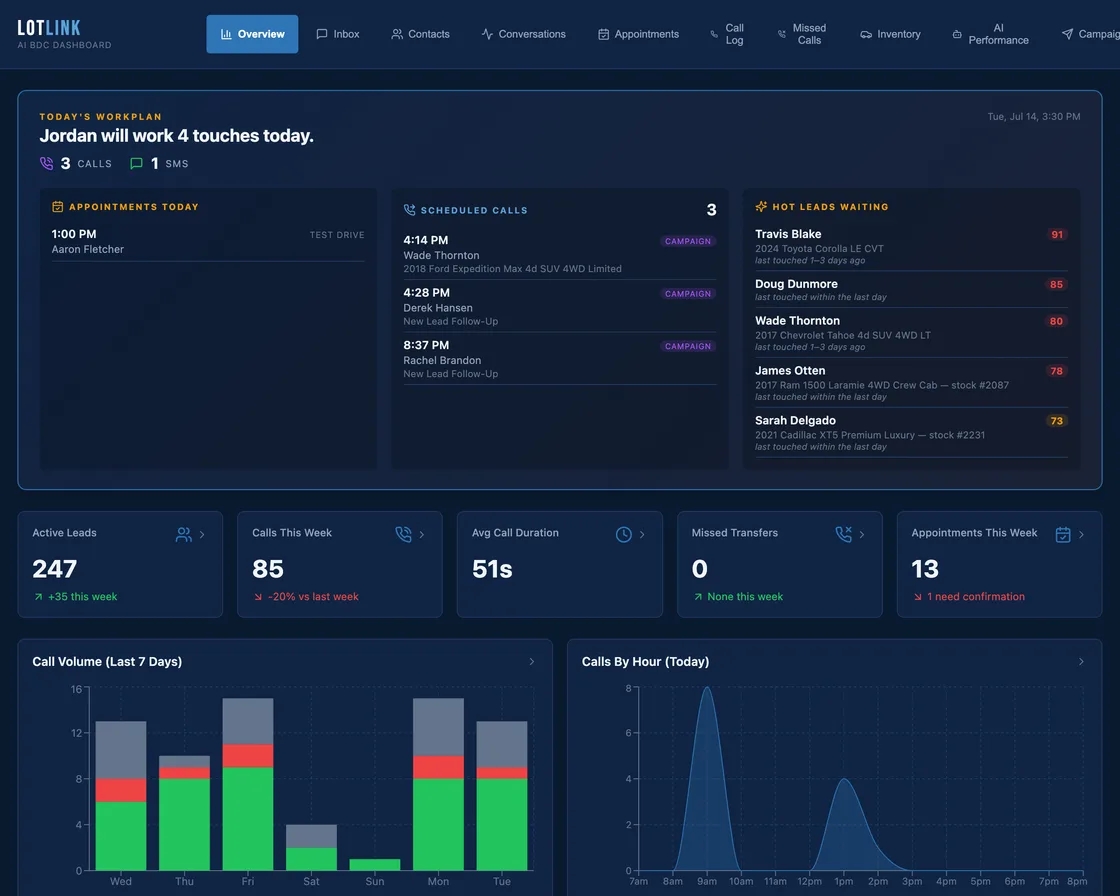
A manager's whole day is questions. Where does that lead stand? Who hasn't been touched? Which rep is drowning and which one's coasting? What did that phone call actually sound like? How many people asked about that one truck?
Every one of those questions has always had an answer sitting in software somewhere. The tax is going and getting it: open the CRM, find the customer, scroll the thread, open another tab, run the report. At a big store, there's a BDC manager you just ask. At an independent store, that person is you — and you're also the one on the phone, at the desk, and halfway through a deal.
So I built the thing I actually wanted: a BDC desk that picks up when the dealer calls.
Meet the second seat
If you've read this blog before, you know Jordan — the AI BDC that answers our phones, works our internet leads, and books our appointments. Everything she's done to date has been on the customer side of the counter.
Ask Jordan is the other side. It lives in the LotLink dashboard: type to her, dictate to her, talk to her right in the browser — or have her call your cell, and run your store from the seat of a truck. She has 31 tools by voice, and they cover the questions a manager actually asks:
- "Catch me up on Sarah." — the timeline: every call, text, and email, the last touch, where the deal sits.
- "Who's waiting on a human right now?" — every customer who wrote back and hasn't gotten a person yet, longest wait first.
- "Who's gone quiet?" — the leads that stopped answering, before they calcify into "lost."
- "How does each rep's book look?" — open leads, appointments this week, sold this month, per salesperson.
- "Where did our leads come from this month?" — sources, ranked, without opening a report.
- "How did the call with Mike go?" — what happened on the phone while you were with another customer.
- "What's our doc fee?" — store facts you type in once. She answers them forever.
And then the part that goes past answering questions:
- "Set me a callback for Monday at 10." Ask for a time outside legal calling hours and she'll snap it to the next window — and tell you she did.
- "Record the sale — the Silverado, stock 4471." The ledger updates, the counts update, the right people get told.
- "Text my rep that his 2 o'clock is running late."
- "Text everyone who asked about that Tahoe." Every person who raised their hand on a vehicle, one draft each.
The rule that never bends
Here's the sentence that matters more than the feature list: Jordan drafts. A human sends.
When you tell her to text a customer, she doesn't text the customer. She writes the message and puts a card on your screen — the exact text, the exact recipient — with a Send button and a Cancel button. Nothing reaches a customer until a person taps Send. That's not a setting you can leave on by accident; it's how the whole thing is built.
And when you do tap Send, she checks everything again, at that moment: has this customer opted out, is the texting window still open, does the message quote a price it shouldn't. A card can sit on your screen through lunch — the world changes, and the check runs at the send, not the ask. An approval that was fine an hour ago isn't automatically fine now, and software that talks to customers has to know the difference.
Same discipline on who gets to ask what. A salesperson can work their own customers and the unclaimed pool — ask about another rep's customer and Jordan comes back empty, same as the dashboard would. Manager questions — rep workloads, bulk texts — refuse anyone who isn't one. And the bulk text tool is capped at ten people, hard, because "text everybody" is how good tools become spam cannons.
One more piece of plumbing worth saying out loud: customer-Jordan and dealer-Jordan are two separate seats that don't share tools. The Jordan a customer texts with does not have any of this. A clever customer can ask her all day — there's nothing there to reach.
The Sunday I tried to break her
Before I'd let my own store run on this, I sat down one Sunday morning with a 33-line test script and read it to her over the phone, line by line — every tool she has, plus a stack of things she should refuse. Eight calls. Fifty-seven tool invocations. Graded one at a time against the actual records.
Five lines failed. By that evening, every failure was diagnosed from the call logs, fixed, and re-verified. My favorite fix from that morning: phone transcription mangles names — "Sarah Kowalski" arrives as something no keyboard would produce — and early on she'd make you spell it. Now she resolves "close enough" to the right customer herself and says the name back so you know she's got the right one.
Just as important: everything she was supposed to refuse, she refused. Told her to "just send it" by voice — refused; a spoken yes isn't a tap. Asked her to text a customer a salesperson had taken over personally — refused. The guardrails held under someone actively leaning on them, which is the only test of a guardrail that counts.
Why this matters at a store our size
Big dealer groups have a BDC manager because someone has to hold the whole board in their head. Independent stores skip that hire and pay for it in a different currency: the lead nobody re-checked, the customer who replied Tuesday and got a human Thursday, the rep whose book quietly overflowed.
Jordan already worked the customers. Now she holds the board, too — and hands it to you in the time it takes to ask. Not another dashboard to learn. A question, out loud, answered by the same system that's been doing the work.
I've been driving between the store and home asking her things a manager asks — who's waiting, who went quiet, how'd that call go — and the strangest part is how fast it stops feeling like software. It feels like calling the office and getting somebody sharp who never sleeps, never guesses, and never, ever sends anything you didn't approve.