
If you'd told me thirty days ago that an AI was about to attribute six car deals to itself at the dealership where I work, I would have laughed at you. I've been on a sales floor my entire adult life. I know what closes cars and what doesn't, and a lot of what gets sold as "AI" is a chat widget that says "Thanks! Someone will reach out shortly" while the lead goes cold.
So here are the receipts.
Six cars. ~$3,200 average per deal — that's the used-car gross average for House of Carz on the units Jordan moved. I'm not counting deals where Jordan touched the lead but a salesperson did the heavy lifting. I'm counting the ones where the trail leads straight back to him: he picked up the phone, he texted at 9pm, he booked the appointment, the customer walked in, the deal closed. Six of those.
This is what thirty days of Jordan actually looks like at one indie dealership:
(inbound + outbound)
sent by Jordan
worked right now
without me lifting a finger
Of those eight appointments, four customers actually walked through the door — and two of them drove off in a vehicle they didn't own that morning. That's a 50% close-on-show ratio, which is the number the industry actually grades on. It would be a strong week for a human salesperson. It's a great month for an AI that booked all eight of those appointments without me lifting a finger.
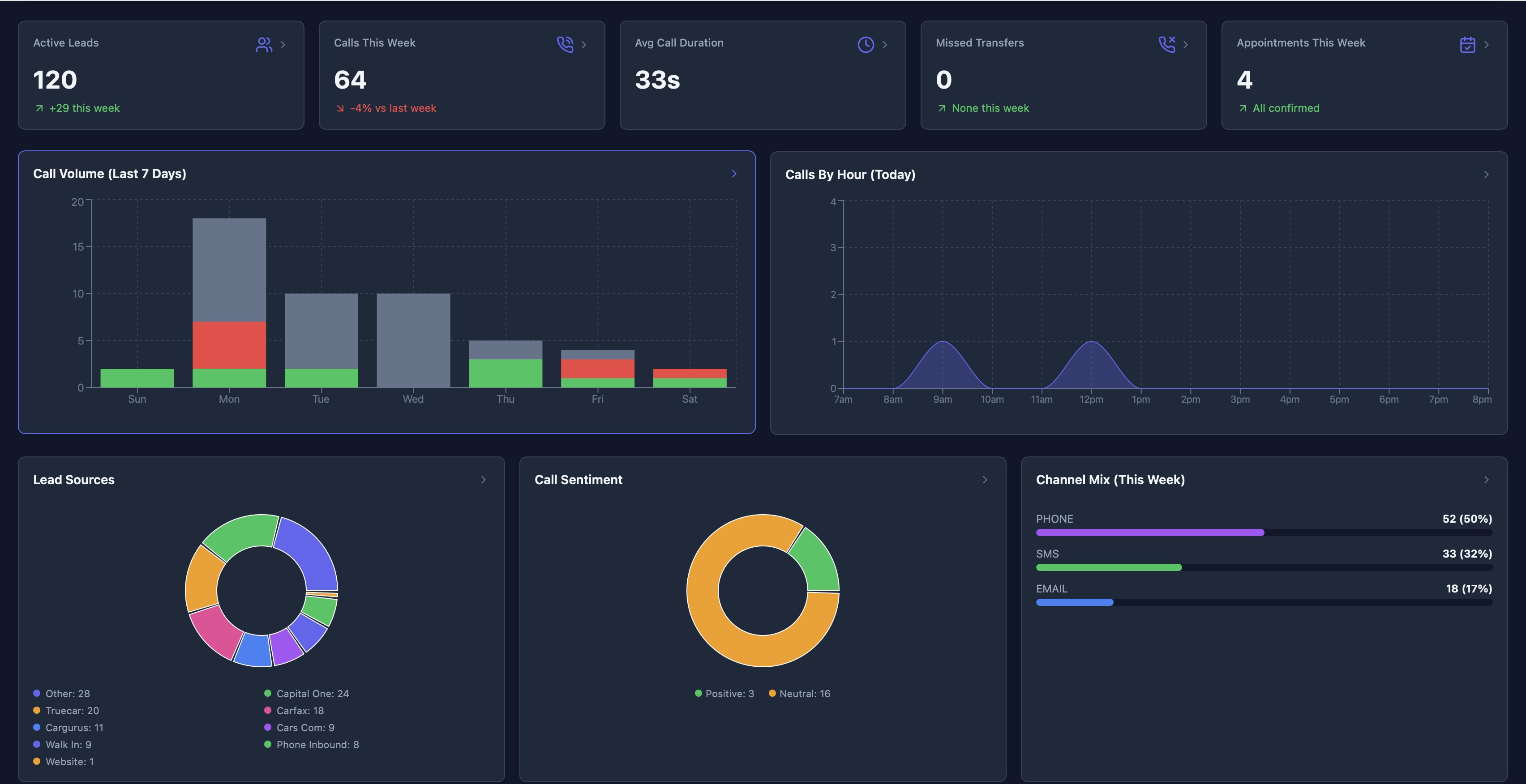
Numbers aren't the whole story, but they're not nothing either. Before Jordan, an after-hours lead at House of Carz had maybe a 30% chance of getting a callback the next business day. Not because we don't care — because the lead lands in a CRM nobody opens until 9am, and by then the customer has already texted three other dealers. Jordan's pick-up rate on the same kind of inbound is closer to 100%. He doesn't sleep. He doesn't have a lunch break. He doesn't get a weekend.
The number that actually keeps me from going back to the old way is this one:
Industry benchmark for replying to a fresh web lead at an independent dealership is somewhere between two hours and never. We're at two minutes and twenty-four seconds, with a 73% rate of beating the five-minute window where lead conversion is statistically best, and a zero on leads that never get a reply at all. Those are not numbers I would have believed if I read them on someone else's blog. They're our actual dashboard.
The deals, in plain English
I've already written about two of the six. Brianna's Silverado was Jordan's first close — six days from his first email to her keys, and she walked in a full week before her booked appointment because his texts gave her enough confidence to come early. Emily Glass was the lead everyone would have written off — eleven Jordan touches, nine days of silence, then she walked in unannounced because she'd seen our sign across the street and remembered Jordan's name.
The other four were quieter. A guy who called at 9:47pm on a Saturday — we were closed, Jordan answered, qualified him on a truck, scheduled a Monday morning test drive. A trade-in inquiry that came through the website at 6am and was already on my calendar by the time I got my first coffee. A customer who'd ghosted me for two weeks, started replying to Jordan because Jordan asked the right follow-up question, and ended up trading a Civic for an Equinox. And a sixth that closed the same morning I sat down to publish this post — Jordan had booked the appointment the day before; the customer showed up, drove the car, signed the papers.
None of those four are stories you can build a brochure around. They're just dealership work, done — work that would otherwise have sat in an inbox waiting for me to find time.
What surprised me
Three things, in order of how much they surprised me.
One — the email replies. I expected the SMS auto-reply to do work. I didn't expect customers to actually have email conversations with Jordan. Multi-turn, asking about features, asking about financing, sending back vehicle photos they liked. Email is supposed to be dead in our industry. Apparently it's not — we'd just stopped replying fast enough for it to matter.
Two — the voice quality. Within the first week I had three customers tell me on the lot, unprompted, "I talked to Jordan yesterday, he was real helpful." None of them realized Jordan was AI until I told them. Two of them didn't believe me until I played the call recording. The third one didn't care and bought the truck anyway.
Three — the hot-lead alerts. Jordan sends me a text when a conversation gets serious — when a customer asks about financing, mentions a trade-in value, or says something that means "I'm ready to buy." Those alerts have been more useful than any CRM tag I've ever set up. It's not "Lead Score: 87" — it's "Joyce just mentioned she has $4,000 down and wants to come in Saturday." I don't have to interpret anything. I just call her.
What it cost vs. what it made
House of Carz pays a grandfathered rate I won't bore you with. If you priced this at the public Pro tier — which is what most independent dealers will land on — that's $2,499 a month, or about $83 a day. The six deals attributed to Jordan over 30 days brought in roughly $19,200 in gross. The math isn't subtle — that's almost an 8x return on the seat in the first thirty days.
Even if you assume I'm being generous on attribution — cut it in half, call it $9,600 — that's still nearly 4x in the first thirty days, on a platform that runs while you sleep and doesn't ask for a raise. The math doesn't have to be elegant. It just has to work.
What I'd tell another indie dealer
If you're running an independent lot under 200 units a year, and your "BDC" is one tired person on Tuesday morning trying to catch up on the weekend's missed calls, this is the tool. It is not going to replace your salespeople. It is going to give them a teammate who picks up the phone at 9pm and doesn't drop the ball on a follow-up text six days later. The salespeople still close cars. Jordan just makes sure the cars get to the salespeople.
I'm putting it on the road. The first ten dealerships get Founding Partner pricing locked in for life — locked in even after we raise rates, which we will. As of this post, nine of those spots are still open. If you've read this far, you're the kind of dealer this was built for.